The maintenance request that never gets logged



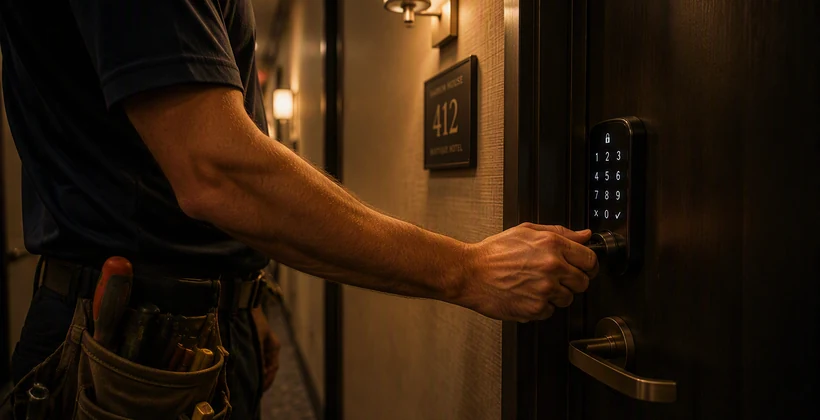
A guest calls down about a leaky faucet. Someone from maintenance heads up, fixes it, and moves on to the next thing. A week later, if anyone asks who was in that room and when, the honest answer is usually a shrug. The work got done. The record of it didn't.
Why this gap exists in the first place
Independent hotels rarely have a dedicated system for tracking room access outside of guest check-in. Maintenance requests come in through a call, a text, a note left at the front desk. None of it naturally produces a record of who actually entered a room, because nothing in that workflow was built to capture it.
What the gap actually costs
Most of the time, nothing. Every so often, it costs a lot: a guest disputes something about their stay, an item goes missing, and there's no way to confirm who was in the room and when. The absence of a record doesn't create the problem, but it makes every version of the problem harder to resolve.
Independent hospitality insights, straight to your inbox
Subscribe for practical operations guidance built for boutique hotels and independent properties.
Closing the gap without adding a step
The fix isn't asking staff to log every visit by hand, since that's exactly the kind of task that quietly stops happening under pressure. It's connecting room access to the credential itself, so every entry is already recorded the moment it happens, without anyone having to remember to write it down.
What this looks like day to day
A maintenance credential opens the room and, in doing so, creates a timestamped record automatically. If a guest calls back a week later with a question about their stay, the answer isn't a guess. It's already sitting in the access log, exactly where the visit actually happened.
A pattern independent properties are already living with
Thatch, an independent hospitality operator, went through a version of this shift as their property grew past the point where informal tracking held up. You can read more about how Thatch approached access across their properties. The lesson holds broadly: the record is worth far more when it's automatic than when it depends on someone remembering to create it.
Why this matters beyond the rare dispute
Most maintenance visits never become a problem. But an independent property that can point to a clear, automatic record every time it's asked builds a kind of trust that's hard to put a price on, both with guests and with insurance providers who increasingly expect some form of access documentation as a matter of course.
It also changes how a small maintenance team operates day to day. A single person handling repairs across a boutique property can move faster when they're not also expected to separately document every stop. The record exists because the door was opened, not because someone remembered to write anything down afterward.
A smaller property's version of this problem
Even a property with a single maintenance person on staff benefits from this, maybe more than a larger one. A one-person operation has no backup way of reconstructing who did what, since there's only one person to ask, and their memory of a specific Tuesday afternoon three weeks ago is exactly as reliable as anyone else's would be.
The record also protects that same maintenance person. If a guest's complaint turns out to be unrelated to the actual repair, an automatic log clears that up quickly, rather than turning into a drawn-out he-said, she-said between a guest and a staff member trying to recall a routine visit.
What to look for when evaluating a fix
Not every access system captures this kind of record automatically. It's worth confirming, before relying on any system for this purpose, that entries are actually logged with enough detail to be useful later: which credential, which door, what time, not just a vague note that something happened.
This same principle, letting the credential do the documentation, shows up again in how properties handle busier moments too. Group bookings and events create their own version of this record-keeping challenge, just at a larger scale.
See how it works
See how access logs give independent hotels a record they don't have to chase down.

RemoteLock has been automating access control and improving on-site property operations efficiencies across multiple industries, including vacation rental and multifamily, for more than ten years. As a leading access-centered property operations software platform provider with more than 10,000 customers in 75+ countries, RemoteLock helps property managers enable, control, and automate access and climate control across their portfolio. RemoteLock’s platform saves property managers time and money through the elimination of tasks for onsite staff and helps scale businesses with greater confidence. It is differentiated by its dozens of integrations with applicable hardware and business software systems for an easy-to-use, turn-key solution.
Access that Works Everywhere
One flexible platform built to support modern properties, no matter who needs access or how your portfolio scales

Interested in learning more?
Explore blogs, webinars, and videos related to what you just read

When the internet drops, your guest still needs to get in
Access that matches the schedule, not the other way around
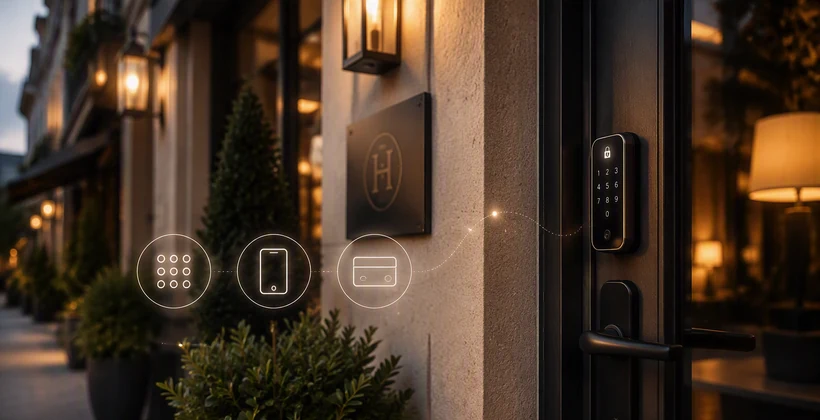
Choosing the right access credentials for your boutique hotel: PINs, mobile, cards, and when to mix them