Creating a seamless hotel guest journey through connected technology



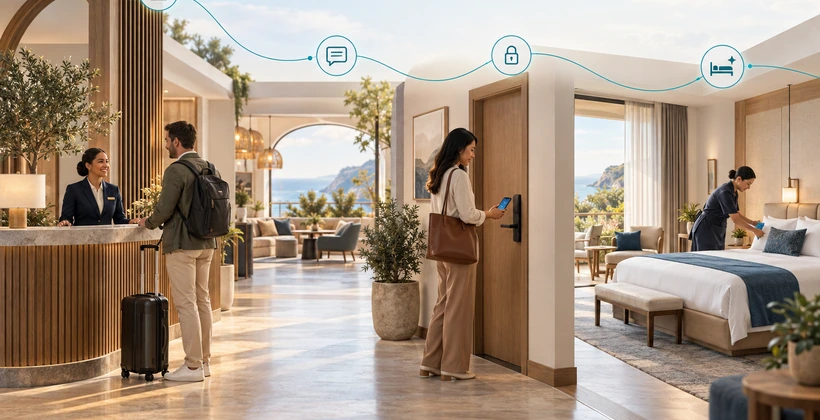
A guest's experience doesn't start at the front desk. It could be an ad, a search result, or even an Instagram post, and from that first interaction to the final checkout, every touchpoint shapes how they perceive your hotel.
Behind the scenes, that one continuous experience runs through many teams and systems: marketing, reservations, access control, guest messaging, housekeeping, payments, and more.
When those systems don't communicate, guests feel the disconnect. They repeat information they've already shared, wait for rooms that should've been ready, and receive generic messages with no relevance to their stay.
A connected guest journey is the opposite. Information a guest shares once travels to every team and tool that needs it, so each stage builds on the last.
A connected journey is a chain of promises
Guests don't experience your technology. They experience a sequence of promises. The listing promises a quiet room near the pool; the confirmation promises an easy arrival; check-in promises that you know who they are. Each stage keeps the promise the last one made or breaks it, and the break is the part they remember.
Whether a promise holds usually comes down to the information behind it. When a guest completes digital check-in, a connected hotel can issue their room access, update the room status, and let the front desk know they're on the way. In a disconnected one, a hotel might not realize a guest is on their way until they're standing at the front desk.
Manual handoffs like this are common. 67% of independent hotels still struggle with disconnected systems, and teams in the same report described spending one to two workdays a week reconciling data between tools.
Connection shouldn't equate to automating every interaction, but capturing information once, sharing it everywhere it's needed, and letting people, and increasingly AI, act on it.
Before arrival: Set expectations, then capture what you need once
From the photos and descriptions on your website to the amenities and policies outlined during booking, every interaction shapes what guests expect from their stay. Clear, accurate information helps set the right expectations from the beginning.
Once a reservation is confirmed in the PMS, pre-arrival communications offer an opportunity to learn more about the guest and prepare for their needs. Platforms like Cloudbeds can serve as the central hub for this journey, connecting reservation data with the tools hotels use for guest communication, operations, and access throughout the stay.
Expected arrival times, room preferences, special occasions, and accessibility requirements can all help hotel teams deliver a more personalized experience.
But collecting information is only half of it. It also needs to reach the people who will use it. When guest preferences and requests are connected to the reservation, front desk and housekeeping teams can prepare accordingly without relying on manual updates or back-and-forth communication.
Hotels can also collect identification and payment details securely in advance, reducing paperwork and helping simplify the arrival experience.
Check-in: Give guests the arrival experience they want
Not every guest wants the same check-in experience. Some prefer to skip the front desk and head straight to their room, while others appreciate a quick introduction to the property.
With connected systems, hotels can offer both without creating extra work for staff.
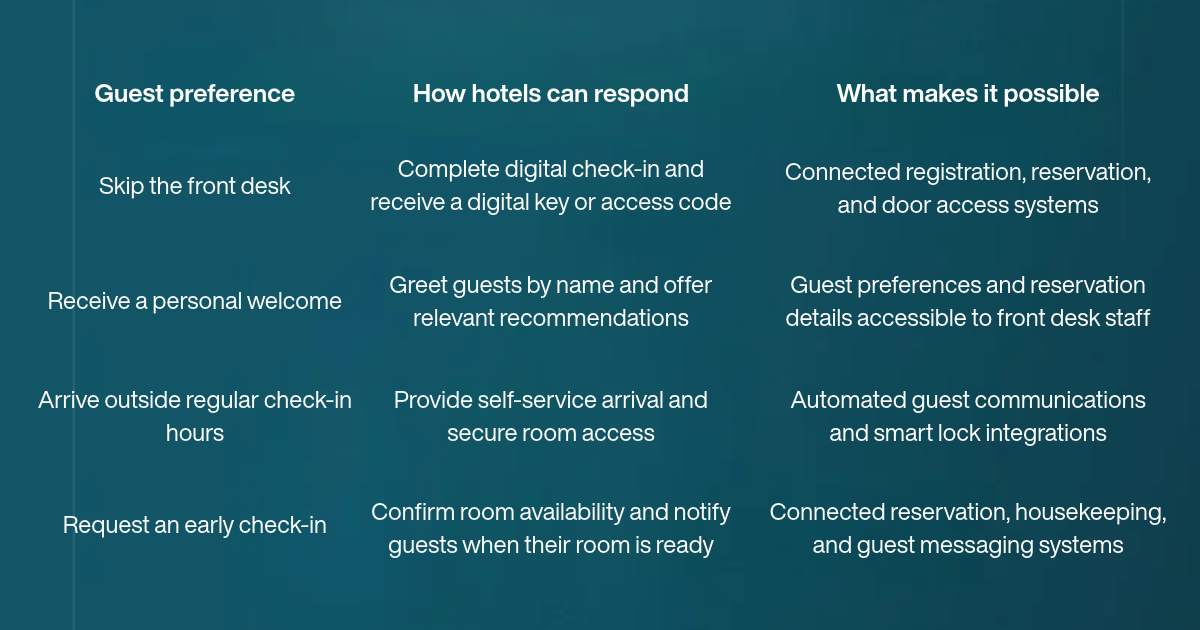
For guests who prefer a contactless arrival, digital check-in and smart lock integrations can make it possible to complete registration, receive access credentials, and enter their room without stopping at the front desk.
For those who prefer a more personal experience, front desk teams can access reservation details and guest preferences in advance, allowing them to provide a warm, informed welcome.
Here's how connected technology can support different arrival preferences:
During the stay: Anticipate needs and respond faster
Once guests have settled in, connected systems help hotels deliver attentive service without requiring constant manual follow-up.
For example, an automated message shortly after check-in can give guests an opportunity to share feedback or raise concerns while there's still time to address them. If someone requests extra towels or reports an issue with their room, that request can be routed directly to the appropriate team, with clear ownership and visibility into its status.
Connected guest data also creates opportunities for more personalized experiences. A guest celebrating a special occasion might receive a relevant dining recommendation, while a returning visitor could be offered an experience based on their previous stay.
AI and automation can take this a step further.
When AI-powered guest assistants have access to accurate property information, reservation details, and guest preferences, they can provide more relevant responses, answer stay-specific questions, and help coordinate requests across departments.
Rather than simply answering frequently asked questions, these tools can become an extension of the hotel team, helping guests get what they need faster while allowing staff to focus on interactions that benefit from a personal touch.
Check-out and beyond: Make every stay the start of the next
Check-out is the last thing guests remember. When folios, payments, and room status are connected, a guest can leave without fuss. Door access expires on its own at check-out, and housekeeping knows the room is free.
The stay doesn't end there. Everything captured along the way, from preferences to requests to feedback, becomes the basis for a follow-up that sounds like it came from someone who was paying attention. That includes a thank-you that references the stay, a review request timed well, an invitation that reflects what the guest actually enjoyed.
More guest access insights, straight to your inbox
Subscribe for practical tips on lock connectivity, PIN management, and keeping guests moving in and out without a hitch.
How to start building a more connected guest journey
Creating a connected guest journey doesn't mean replacing your entire technology stack. Instead, start with the fundamentals:
- Map your current guest journey. Walk through every stage, from booking to post-stay follow-up, and note where guests experience delays, repeat information, or encounter unnecessary steps.
- Identify your biggest opportunities. Review guest feedback and speak with your team to understand where disconnected processes cause the most friction. Prioritize improvements that will have the greatest impact on the guest experience.
- Evaluate your existing integrations. Look at how your hotel PMS connects with guest messaging, housekeeping, door access, and other technologies. Does information sync automatically? Are updates reflected across systems?
- Give guests flexibility. Make sure your technology supports different preferences, from contactless check-in and keyless entry to traditional front desk service, without creating disconnected experiences.
- Automate repetitive tasks. Start with straightforward workflows like sending confirmations, generating access codes, updating room status, and routing guest requests. These small improvements can save staff time and reduce opportunities for error.
- Measure and improve. Track check-in times, guest satisfaction, response times, and recurring service issues. Use these insights to refine your processes and identify opportunities for further integration.
Better connections, better guest experiences
A great guest experience isn't defined by any single interaction. It's the result of every touchpoint working together, from the first booking to the final follow-up.
When hotel systems communicate and information flows between teams, guests enjoy a more seamless, personalized stay, and staff can spend less time managing manual processes and more time delivering great hospitality.
See how RemoteLock works for hospitality
Explore access automation by connecting smart locks, sensors, and property management software into one centralized platform.

Cloudbeds is the hospitality management system built for ambitious hoteliers who demand more. The Cloudbeds platform unifies operations, distribution, guest experience, and revenue marketing, giving operators a breadth of tools to capture demand, grow direct bookings, optimize pricing, maximize upsell revenue, and act on real-time intelligence within a single system. Designed to scale with independent hotels, large hotel groups, and multi-property portfolios, Cloudbeds is trusted by tens of thousands of properties in more than 150 countries.
Access that Works Everywhere
One flexible platform built to support modern properties, no matter who needs access or how your portfolio scales

Interested in learning more?
Explore blogs, webinars, and videos related to what you just read

When the internet drops, your guest still needs to get in
What happens to restaurant access when someone quits mid-shift
Makerspaces, conference rooms, and the access problem libraries didn't used to have