Makerspaces, conference rooms, and the access problem libraries didn't used to have



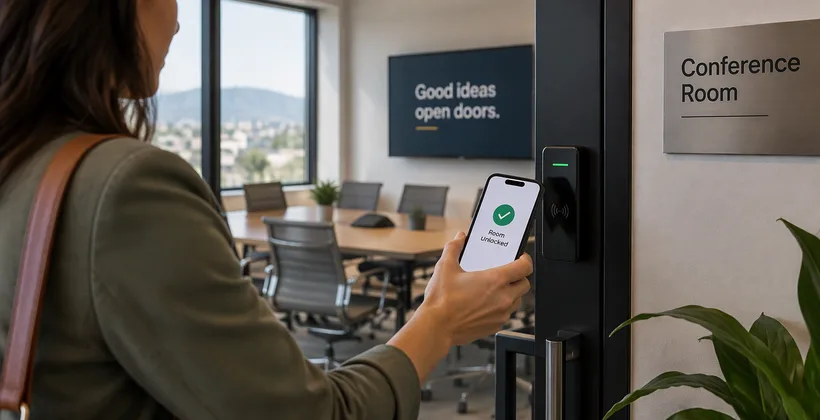
A library used to mean stacks, a reading room, and a front desk. Many libraries now also run makerspaces with 3D printers, bookable conference rooms, recording studios, and community meeting space. None of that came with a playbook for who gets in, and when.
Why this snuck up on a lot of libraries
The expansion into shared spaces happened gradually, one new room or piece of equipment at a time. Access for each one usually got solved the same improvised way: a staff member unlocks it, a sign-up sheet at the desk, a key that lives in a drawer somewhere.
What breaks as the number of spaces grows
One makerspace with a sign-up sheet is manageable. A branch with five or six bookable spaces, each with its own informal system, stops being manageable fast. Staff spend real time just tracking who's supposed to be where, time that has nothing to do with actually running library programs.
Modern library operations, straight to your inbox
Subscribe for practical guidance on access, shared spaces, and reducing manual work at the desk.
What's actually filling the gap
Access control built around reservations treats every bookable space the same way, regardless of whether it's a conference room, a makerspace, or a piece of equipment. A reservation creates access. The reservation ending removes it. No sign-up sheet, no key in a drawer.
Why this matters more for libraries than it looks like it should
Libraries serve the public, which means the person booking a makerspace slot often isn't someone staff know personally. Connecting reservation software directly to access, rather than relying on staff recognition or an honor system, closes a real gap that grows as a library's shared-space footprint grows.
What it frees staff up to do instead
None of this replaces staff. It removes the part of the job that was never really about serving patrons in the first place, the manual tracking of who has a key to what, so that time goes toward the programs and services libraries actually exist to provide.
What this looks like at scale across a library system
A multi-branch system faces this problem many times over, since each branch may have developed its own informal solution independently. Centralizing access around reservations gives every branch the same underlying system, even if their spaces and schedules look completely different from each other.
It also creates a level of consistency patrons notice, even if they can't name it directly. A makerspace at one branch behaves the same way as a conference room at another: book it, get access for exactly that window, and nothing more complicated than that.
Where to start if this feels overwhelming
A library doesn't need to solve every shared space at once. Starting with the highest-friction space, usually the one generating the most staff questions or the most confusion about who's supposed to be where, gives a concrete place to prove out the approach before expanding it further.
Once one space is running this way, extending the same model to the next one is mostly a matter of repetition rather than a fresh project. The hard part is almost always the first space, not the second or third.
What success actually looks like
It rarely looks dramatic. Mostly, it looks like staff no longer being asked the same access questions several times a day, and patrons no longer needing to track someone down just to use a room they already reserved.
It's also worth revisiting this periodically as new spaces get added. A library that solves this once for its current footprint should expect to keep applying the same approach as programming and community demand continue to evolve over time.
Libraries that get ahead of this tend to have an easier time introducing new kinds of spaces down the line, since the underlying access approach already scales to whatever gets added next.
Over time, this data becomes useful in its own right. A year of reservation data can tell a library a lot about how its shared spaces actually get used.
Schedule a demo
See how reservation-based access covers every shared space in a library.

RemoteLock has been automating access control and improving on-site property operations efficiencies across multiple industries, including vacation rental and multifamily, for more than ten years. As a leading access-centered property operations software platform provider with more than 10,000 customers in 75+ countries, RemoteLock helps property managers enable, control, and automate access and climate control across their portfolio. RemoteLock’s platform saves property managers time and money through the elimination of tasks for onsite staff and helps scale businesses with greater confidence. It is differentiated by its dozens of integrations with applicable hardware and business software systems for an easy-to-use, turn-key solution.
Access that Works Everywhere
One flexible platform built to support modern properties, no matter who needs access or how your portfolio scales

Interested in learning more?
Explore blogs, webinars, and videos related to what you just read

When the internet drops, your guest still needs to get in

How independent hotels compete on guest experience without a big-brand budget
The 6am delivery problem: giving vendors access without giving up control