Beyond the front door: what modern access control means for commercial properties



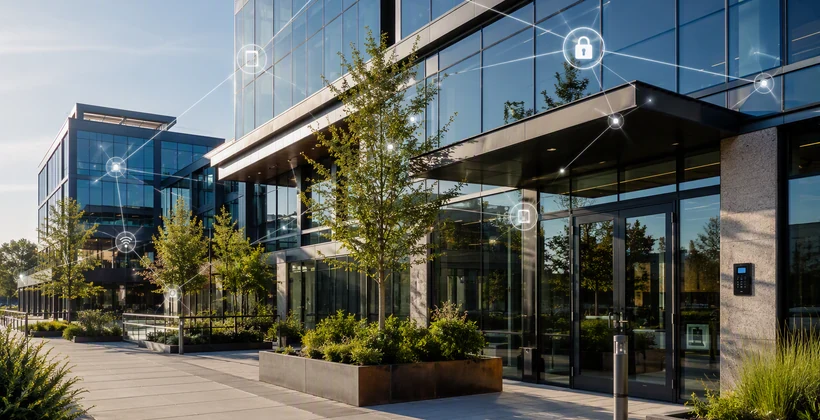
Ask most people what access control means for a commercial property and they'll picture the front door. That's the smallest part of the job. The real work happens at the visitor desk, on multi-tenant floors, in the loading dock a vendor uses at six in the morning, and in the after-hours windows when someone needs to get in without anyone standing there to let them in.
The front door was never the hard part
Main entrance access is largely solved. Most commercial properties have had some version of a badge reader or keypad at the lobby for years. What's harder is everything downstream of that first door: routing a visitor to the right floor without an employee walking them there, giving a vendor a scheduled window of access instead of handing over a standing key, and keeping an audit trail that actually holds up when something needs to be reviewed months later.
Those are the problems that determine whether a building runs smoothly or whether the front desk spends its day chasing down who's supposed to be where.
Why one system needs to run the whole building
A centralized approach to access control is about far more than locking and unlocking a door. Modern systems are expected to manage identity, timing, and reporting across an entire building, not just its entrance. That means knowing not just who has a key, but when they're allowed to use it, which doors it opens, and what record gets left behind when they do.
For a commercial property with multiple tenants, contractors rotating through, and staff working different shifts, that level of detail isn't a nice-to-have. It's the difference between a system a property team can actually rely on and one that requires constant manual correction.
Stay connected to the latest in access control
Get insights on hardware, integrations, and property operations delivered to your inbox.
Visitor management and multi-tenant floors
A visitor checking in at the lobby should get exactly the access they need, and nothing more, automatically. That means the right floor, the right suite, and nothing beyond it, without a property manager manually configuring a temporary credential every time someone from outside the building has a meeting.
On multi-tenant floors, that same logic needs to hold for every tenant's staff and vendors without one tenant's system interfering with another's. A cleaning crew working for one tenant shouldn't be able to wander into a neighboring suite, and a badge issued for one company's staff shouldn't quietly work for a different company's space just because they share a floor.
After-hours vendor access
Vendors rarely work standard business hours. HVAC technicians show up before the building opens, and deliveries land on loading docks well after everyone else has gone home. Wired access hardware that wasn't designed for scheduled, temporary credentials tends to fall back on standing keys, which quietly become a long-term liability the moment a vendor relationship ends and nobody remembers to collect the key back.
A scheduled credential solves this cleanly: the vendor gets access for the exact window they need, and it expires on its own. No key to track down, and no gap between when the job is done and when access should have ended.
The audit trail that actually holds up
Access control data, read consistently, becomes a real operational record instead of something pulled up only after a problem. Hogsalt restructured its access approach around exactly this kind of visibility, and the result wasn't just tighter security, it was a property team that could answer who was in a space and when in minutes instead of days. Read more in how Hogsalt reinvented operational access with RemoteLock.
Access control as part of a bigger system
None of this happens in isolation. Front-desk visitor management, elevator credentials, and after-hours vendor windows all touch the same underlying question: does the person standing at a door have permission to be there right now. Elevator access control is a good example of where this shows up directly. When the credential a visitor checks in with at the lobby is the same one that gets them to the right floor, there's one less system for a property team to keep in sync.
The properties that get the most out of access control aren't the ones with the most hardware. They're the ones where every door, every credential, and every schedule is pulling from the same source of truth.
Talk to our team
See how a modern access platform covers a commercial property well beyond the main entrance.

RemoteLock has been automating access control and improving on-site property operations efficiencies across multiple industries, including vacation rental and multifamily, for more than ten years. As a leading access-centered property operations software platform provider with more than 10,000 customers in 75+ countries, RemoteLock helps property managers enable, control, and automate access and climate control across their portfolio. RemoteLock’s platform saves property managers time and money through the elimination of tasks for onsite staff and helps scale businesses with greater confidence. It is differentiated by its dozens of integrations with applicable hardware and business software systems for an easy-to-use, turn-key solution.
Access that Works Everywhere
One flexible platform built to support modern properties, no matter who needs access or how your portfolio scales

Interested in learning more?
Explore blogs, webinars, and videos related to what you just read

When the internet drops, your guest still needs to get in
The maintenance request that never gets logged
Access that matches the schedule, not the other way around